Cutting Down Trees is Not Progress: Choose Compassion Over Chainsaws!

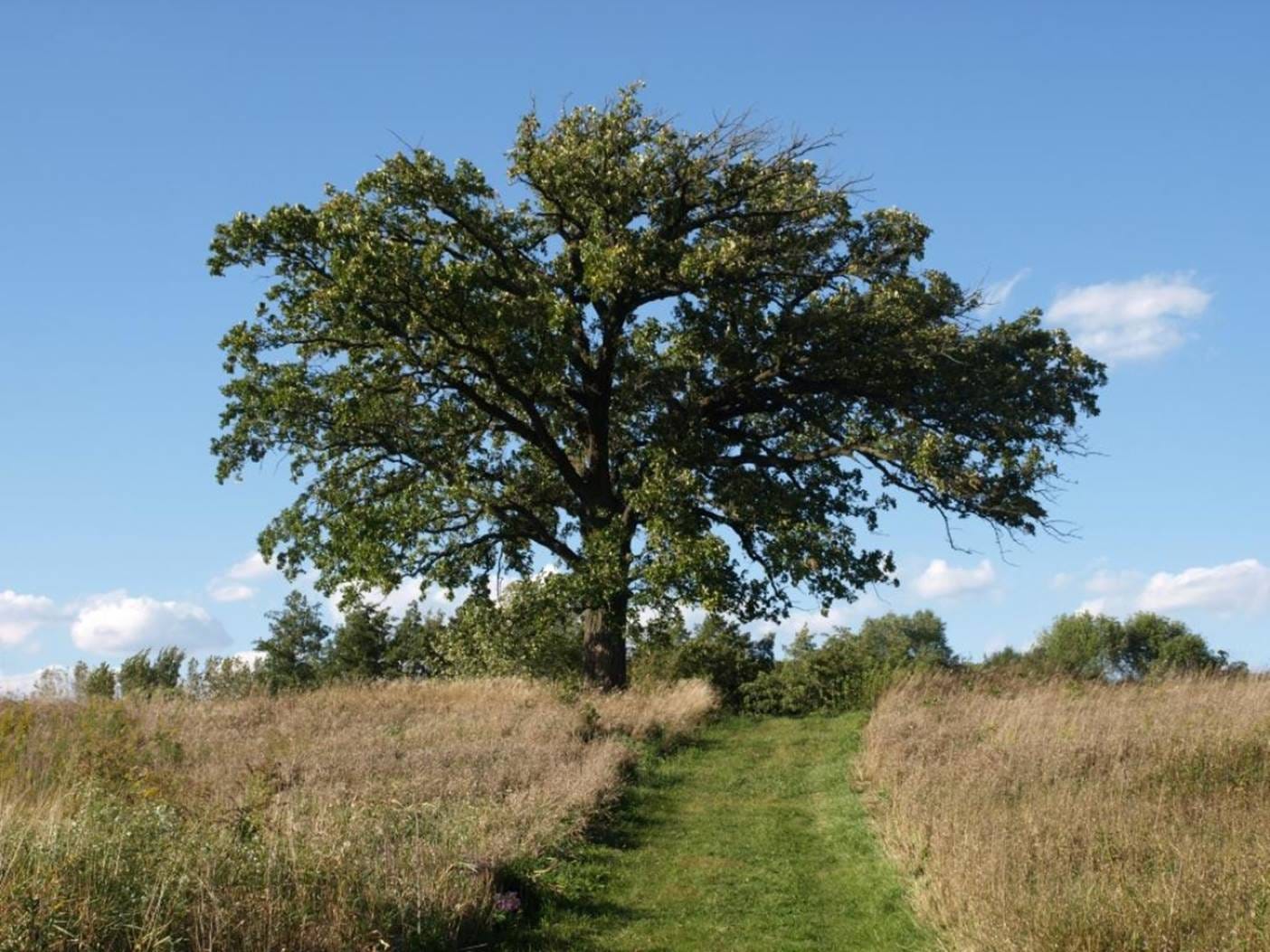
My friend and neighbor Tony loved planes so much he decided to build one in his garage. Sadly, he didn’t get to finish it as he succumbed to prostate cancer. I know he loved our community trails, so I planted bur oak acorns in his memory.
My dear friend Burt used to love walking on our forest preserve trails. He relished one trail in particular, where ancient bur oaks arched over it. He called it a “cathedral,” echoing Ralph Waldo Emerson’s view that nature united us with the divine.
I’m one of those people who think nature is sacred. It allows us to transcend our daily woes and lifts us to a higher place. It was a sanctuary during COVID and serves that purpose now. It’s also good for our physical, mental and spiritual well being. As a Master Naturalist, I can share mountains of research.
So I was stunned when my colleagues on our county forest preserve commission voted to allow the local (Waukegan) airport to cut down up to 800 trees, including some 600 bur oaks.
I had a chance to read the tree survey the forest preserve staff commissoned -- that I only saw after the committee vote was taken on the “de minimus” designation that gave the local airport a legal excuse to say that the tree slaughter posed minimal impact.
Most of the trees targeted – more than 600 – were bur oaks. They ranged in height from 40 to 70 feet. In general, a mature tree can absorb 48 lbs. of C02 per year. That’s about 20 tons total a year for the forest preserve area targeted for tree removal.
We’ll not only lose that carbon storage, but we can’t easily replace it with young trees. We’ll also lose the natural filtering capacity of these trees, along with their shading and anti-flooding properties. Bur oaks, by the way, are nature’s champs when it comes to carbon storage. And they can live for centuries.
Thanks for reading and please share! Please upgrade to a paid subscription to support my work. Readers receive serialized chapters from my new book “The Natural Neighborhood.”
The harsh truth is that eliminating trees will definitely harm people. Private corporate jets pollute the air quickly. Just one hour of flying can add 2 tons of CO₂ to our skies. Unless there’s a mitigation plan, public health is threatened. The trees will be sacrificed for “safety” reasons, the airport authority claims. Yet it’s unclear whether the Federal Aviation Administration will hold a public hearing or complete a full environmental assessment. The agency didn’t commit to anything in writing.
What’s at stake? A recent American Lung Association Survey gave the airport area an “F” rating for air quality, which harms thousands in our county who suffer from asthma, COPD, cardiovascular disease and other maladies. If some 2,000 extra flights – the last number I saw – are projected, then the air quality will be worse, especially in the summer when smog and deadly particulate matter levels are elevated. I asked about the district’s air quality mitigation plan. NO response. I don ‘t think they have one.
There are a number of schools, parks, golf courses and churches in the area. With hundreds of trees cut down, which filter the air and absorb carbon dioxide, air quality will not improve. I know we’re mostly focused on land issues, but we can’t ignore the air that may make people sicker.
Who will get sick? There’s more than 8,000 children with pediatric asthma in Lake County. Nearly 60,000 adults have asthma, 45,000 have cardiovascular disease, 33,000 have COPD. These people will be breathing worse air and may end up in emergency rooms.
This is not progress and it’s reprehensible, irresponsible stewardship. This is all for an airport the vast majority of us will never use. The harm to public health and the loss of the environmental cleansing capacity of the destroyed trees is unacceptable to me. This is not about preserving or protecting nature – which is our mission – this is about profit. Mostly corporate executives fly private jets. They don’t live near the airport. Such a facility would never be built near their multi-million-dollar estates or country clubs on the North Shore. Waukegan already has five superfund sites and dangerously dirty air. It’s not an issue for all but two of my colleagues, most of whom basically looked the other way on the glaring compromise of quality of life in an underserved community.
We should be planting millions of trees, not cutting them down. We recently cheered when a county resident agreed to let us protect a multi-century-old tree on their family property. What happened? The hypocrisy burns hotter than a prairie fire. Illinois used to have nearly 14 million acres of forests. Now forests cover only 0.18% of our state. We lost 1 million ash trees alone to the emerald ash borer. We will lose more trees to data centers, development and global warming triggered by fossil fuel pollution.
Do we need to create jobs? Absolutely! We need living-wage jobs in the trades to replace electricians, plumbers and carpenters who are retiring. We also need to hire more arborists, ecologists and support staff. And we need more people to plant and nurture/restore our trees, wetlands and prairies. It’s not only a growth industry, it should be considered universal well-being care.
It’s a crime to humanity and the natural world to be pillaging brave old souls like bur oaks. I’m sick with grief over this needless destruction. It has kept me up many nights.
We owe it to our children and grandchildren to spell out the negative health and environmental impacts every development project will cause. Progress is enmeshed with perils. Our 250 years of history teaches clearly teaches us that lesson.
Our health, well being and future on this planet depend on our due diligence today. Trees are part of the “green infrastructure” path to address global warming. This century can’t do without them. They are the soul of the solution to our survival.
Sources:
https://theicct.org/pr-air-and-ghg-pollution-from-private-jets-2023-jun25/
https://www.lung.org/clean-air/outdoors/what-makes-air-unhealthy/particle-pollution
Vincit Omnia Veritas
(Truth Conquers All)
This essay was not produced by AI. I am a sentient writer, journalist, author, environmentalist, speaker, musician and elected county forest preserve commissioner who’s written 19 books and contributed to The New York Times, Next Avenue, Bloomberg and Reuters.
As a bonus, subscribers receive free access to my new book “The Natural Neighborhood,” which is serialized in this newsletter: A new chapter every month. To contact me about speaking and writing or offer even more dangerous ideas, email me: johnwasik@gmail.com
Thank you for saying this out loud John! It’s like the FPD thinks the only oaks to be preserved are the ones they own?
Did you know that the very same FPD received thousands of carbon credits for oaks that it preserved? Those credits are potentially worth $10s of thousands of dollars.
If FPDs won’t be advocates for our oldest living residents, who will?