Robin Wall Kimmerer is the Future and Past of Ecology: Traditional Ecological Knowledge is Power and Non-Human Living Entities Should Have Legal Rights

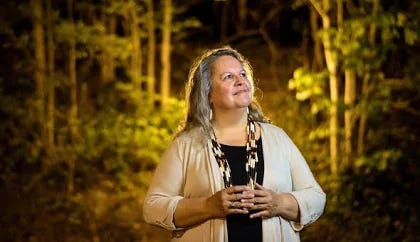
On the grounds on what was once the world’s largest refractor telescope on lands once inhabited by the Potawatomi people, Robin Wall Kimmerer was talking about living things having legal rights.
Dr. Kimmerer, an ecologist, college professor and Citizen Potawatomi Nation member, was discussing a new concept to most Euro Americans: What if we treated trees, deer and squirrels as kin and respected them as members of our family? Not only would it change our view as nature as an object separate from our everyday existence, we wouldn’t commodify earth’s countless “resources” as inanimate things that only have monetary value.
To most non-native North Americans and Europeans, this sounds as radical as relativity and quantum theory did in the early 20th century. Yet this Traditional Ecological Knowledge (TEK) has been around for thousands of years. It’s eons older than western science, but holds wisdom that we should respect and incorporate as we tackle global warming and the pollution that’s killing us.
When Dr. Kimmerer was a graduate student at the University of Wisconsin, her Native American worldview clashed with the western approach to conservation. As conceived by eco-pioneers like Aldo Leopold, who taught at Wisconsin, in the early 20th Century conservation meant “wildilife management,” that is, preserving wild areas, forests, fish and game for hunters and fisherman.
Respect, acknowledgement and reciprocity, in contrast, are at the core of TEK. “First it starts with gratitude,” Dr. Kimmerer notes, where we offer thanks for all of the earth’s many gifts. But we first need to change our language.” Much of her philosophy is detailed in her bestseller “Braiding Sweetgrass.” Although she’s an eloquent scientist/writer, in person she radiates a generous, wise sprit.
She is promoting the TEK view that living things are members of our family and not un-named objects that didn’t even deserve human pronouns. Using Potawatomi language, she discovered a new blended word: bmaadiziaki. Roughly meaning “earth beings,” the word acknowledges the vital energy we share with all living things.
Here’s the language problem, though: English objectifies nature, The environment is not seen as a living entity, but a thing, an “it”.
“Interrogate the word “it” as we consider the gift of language. We “it” the world. English paralyzes us and demands objectification,” Kimmerer said in an earlier talk. “If I called my grandmother, or the person sitting across the room from me an “it”, that would be so rude, and we wouldn’t tolerate that for members of our own species,” Kimmerer elaborated in a 2019 interview. “But we not only tolerate it, it’s the only way we have in the English language to speak of other beings - as “it.”
Kimmerer said objectifying nature is a “moral exclusion,” a divorce from feeling any concern for the Earth. How can we summon strong emotions or ethical objections for trees being clear cut or land ravaged for mining or data centers if “it” is a thing apart from us like a utility pole or a mound of refuse? Suppose we applied human pronouns like “they” or “them” when referring to land, water, plants and creatures?
As an aside, please note: When it comes to new words, I’m like a kid with a cold sherbet popsicle in summer. I love the taste and power of them. I’m proud to say I invented at least one new word into world language: spurb. I know, it sounds ugly and abrades your tongue. It means “sprawling urban area” and describes metropolises that spread like a malign virus in all directions with no center, endless roads and an unsustainable lack of sensible urban planning. Think of strip shopping centers, malls and places with little to no public transportation or green space that seem to go on forever. I digress, though.
Like myself, Dr. Kimmerer believes that language can be both “colonizing and healing. We can reclaim the animacy of language,” she adds. “What if we adopt a way of respecting living beings? They could be seen as kinfolk instead of commodities.”
Dr. Kimmerer notes, with scientific backing, that areas controlled by indigenous people typically have the highest level of biodiversity. They don’t see trees as cash crops or impediments to development. They are not primarily interested in mineral rights. They don’t believe they can possess what’s in the air, land or water. If something is taken from our environment, it must be replaced, which is reciprocity, not resource management or mindless exploitation. Their worldview is truly ecological in a philosophical and biological sense.
We live in a web of interdependence although we “consumers” fill the atmosphere with carbon dioxide and methane; it makes our planet hotter with more violent storms. Many people nod at this reality, but few are willing to accept the fact that Western Culture is deeply rooted in consumption and economic growth and not healthy relationships with the hundreds of millions of other species occupying this planet. It’s our shared responsibility to protect our environment.
Yet how do we belly up to the bar and engage on an emotional level with a strong ethical foundation? How do we move beyond the toxic mantra of “drill, baby drill?” It’s simple, which is signaled by the slogan of Kimmerer’s campaign “Plant, Baby Plant: Raise a Garden, Raise a Ruckus.”
“Drill, Baby, Drill,” that mantra of destruction and extraction, is an intentional slap in the face to people who value land, life, health, and justice over corporate profits. Well, let’s raise a garden-gloved middle finger in return. I invite you, my friends, my neighbors, my readers, my fellow citizens into a new movement called Plant Baby Plant.”
The next significant step is a big one: Conferring legal rights on non-human living things. In New Zealand, the government acknowledged that a river sacred to the Māori people had rights. In Quebec, trees were given legal status.
I can’t honestly say this is progress in the Euro-American sense, because it doesn’t fit in the neat Western box of land ownership, economic development and possession of natural resources. Yet it’s definitely a step forward -- and back -- in how we can better respect nature. Here’s a summary of what could be the seeds for a universal declaration of living-being rights:
Terrasse-Vaudreuil, just west of Montreal, unanimously passed a resolution on June 9 declaring that trees possess “the right to life, natural growth, integrity, and regeneration.” The town is among the first in Canada to endorse the Universal Declaration of the Rights of the Tree. Mayor Michel Bourdeau told CBC “It breathes, it lives, it takes in water. It protects us from all sorts of things. Facing repeated flooding in recent years, the municipality views trees as critical infrastructure. They cool urban areas, sequester carbon, purify air, support biodiversity, mitigate heat islands, and assist with stormwater management. The resolution calls for a review of local bylaws to strengthen tree protection and ensure proper replacement when removals occur.”
Trees, among other biotic entities such as our watersheds, wetlands and prairies, protect us like big brothers and sisters. Not only do they deserve our respect, they are entitled to legal protection. If corporations are regarded as people, why not living entities like trees that absorb carbon, water, nutrients and sources of pollution? They are much more than “critical infrastructure.” They are cherished relatives whom we can rely upon to revive our environment, climate and spirit.
Vincit Omnia Veritas (truth conquers all)
This essay was not produced by AI. I am a sentient writer, journalist, author, poet, environmentalist, speaker, musician and elected county forest preserve commissioner who’s written 19 books and contributed to The New York Times, Next Avenue, Bloomberg and Reuters.
Please consider upgrading to a paid subscription. As a bonus, subscribers receive free access to my new book “The Natural Neighborhood,” which is serialized in this newsletter: A new chapter every month. To contact me about speaking and writing or offer even more dangerous ideas, email me: johnwasik@gmail.com
I love this. Would love to read more of what you have to say on Kimmerer’s work. She is one of the greats.